SECOND CHANCES
john b. cribbs
Despite their reputations, some films and filmmakers just don't do it for Funderburg and Cribbs. This series, Second Chances, follows their attempts to find greatness where they've previously failed to see it; to actively make an effort to appreciate esteemed artworks for which they currently have a distaste (or feel indifference).
They'll give cult favorites like Texas Chainsaw Massacre 2 another shot and dig deep in the filmographies of beloved auteurs whose appeal baffles them (like Luchino Visconti) - and with a little luck, maybe they'll even end up as newly-minted fans...
AN AMERICAN WEREWOLF IN LONDON
john landis, 1981
Happy Halloween, everybody! I trust everyone has finalized their late night horror movie marathon picks. Mine include the 1978 Invasion of the Body Snatchers, Wallace & Gromit: The Curse of the Were-Rabbit, the Tobe Hooper-directed pilot of "Freddy's Nightmares" - it was on the Chiller network so I taped it - and the black & white version of The Mist, the blu-ray of which my brother was forced to pony up after the Raiders bested the Rams by a mere 2 points back in Week Two (should have asked for the spread), to compliment Darabont's debut episode of "The Walking Dead" on AMC. But first I'm taking my daughter Mall-o-ween trick 'r treating at the already kinda-spooky Poughkeepsie Galleria.
However before I exploit my child in order to collect free Kit Kats and Crunch bars, I figured I'd knock out this entry in the 'smoke's on-going Second Chances series. I had planned on re-watching Let the Right One In for this one, but after seeing the virtually identical-plus-crappy-CG American remake I realized that I'm never going to like that film any more than I did the first time out. Which wasn't very much. It really doesn't deserve a second chance because I have no desire to force myself into believing that it's as good as many people say it is. Whereas today's entry is a movie I've struggled with for the last 15 years of my life, a film that - to borrow a line from Sam Cooke's sorrowful rendition of Rodgers and Hart's "Blue Moon" - seems to beg "please adore me." And I desperately want to! So let's see if I can't convince myself of its greatness and turn this moon to gold.
The Subject:
An American Werewolf in London
Initial Resistance:
Attending the Horror Makeup Show at Orlando's Universal Studios theme park back in 1991 was an experience I'm tempted to call "life-changing." But I guess since I didn't go on to become an iconic Creature Creator like Stan Winston or Rob Bottin, I should just call it "awesome." Besides being a great live act, the Makeup Show (one of only three attractions to have remained at the park since its opening, along with Jaws popping out of the water and the shitty E.T. ride) featured a montage of gory scenes from the past decade of Universal productions.
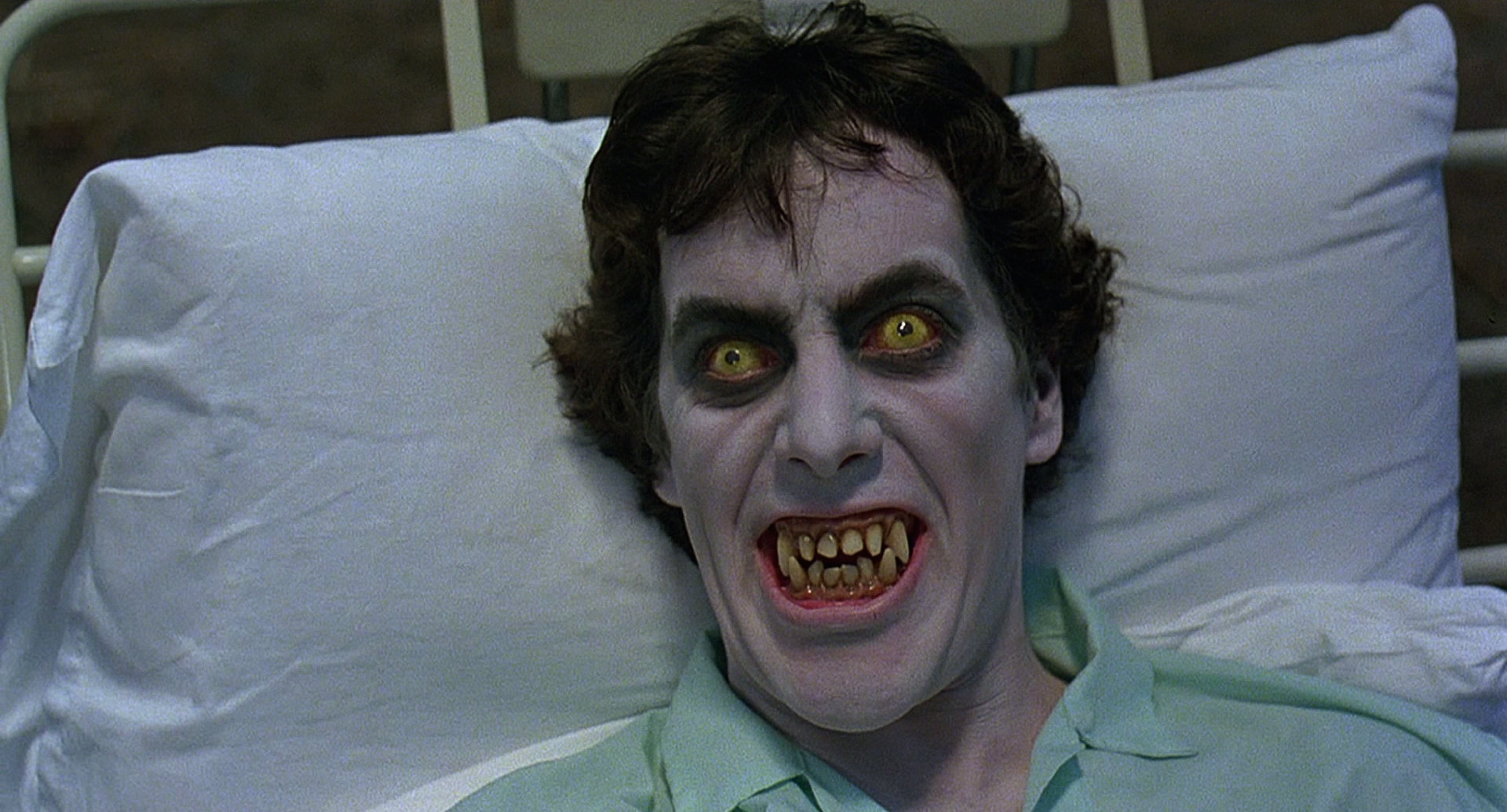
At an ingenuous 12 years old, I caught my first glimpse of several movies that had yet to cross my impressionable radar field with their infamous splatter scenes: Brian DePalma's Scarface (chainsaw in the bathtub), John Carpenter's The Thing (sled dog mutilation), David Cronenberg's The Fly (Brundlefly evolution). And the highlight of these clips was the classic transformation scene from John Landis' An American Werewolf in London, the one for which the Academy Awards had to create a special category to recognize Rick Baker's innovative and groundbreaking effects. I'm pretty sure they screened the entire 2 1/2 minute sequence (which always feels so painfully longer) and by the end of it I sat in my damp seat knowing that this movie had just jumped to the top of my Must See List.
But for some reason I didn't actually catch the complete film for another four or five years, when I was well into high school. Largely as a result of reading Stephen King's Danse Macabre, other horror films had popped into my cultural awareness and the "must see" slot was appropriated by such alternating discoveries as the Alien and Evil Dead movies, and even more obscure titles like Let's Scare Jessica to Death. Of these new favorites, none got spun more than Joe Dante's The Howling. Since both films were released in 1981, Howling and American Werewolf have become unavoidably comparable (people try to include Wolfen in this set of "classic 1981 werewolf movies," but come on, nobody cares about fucking Wolfen.) It's sort of become the modern horror movie version of the "Beatles or Stones" debate: you can like both of them but you'll inevitably prefer one over the other (or is it Beatles vs Elvis? Whatever.)
For me there's no doubt about it - I'm a Howling man. And I'm not just saying that because Joe Dante is clearly a superior filmmaker and storyteller, in fact probably the best American director of the last 30 years (come on - who are you stacking him up against? PT Anderson? David Fincher? Sam Mendes? He's not even American, he just thinks he is.) I've certainly got nothing against John Landis personally. He put slovely John Belushi in a toga, homicidal Dan Aykroyd in a Santa Suit and gorgeous Vanessa Angel in snow bra and panties. On the other hand, he also put Vic Morrow and two children in a needlessly dangerous situation that got them killed. He also directed unnecessary sequels to The Blues Brothers and Beverly Hills Cop. And The Stupids.
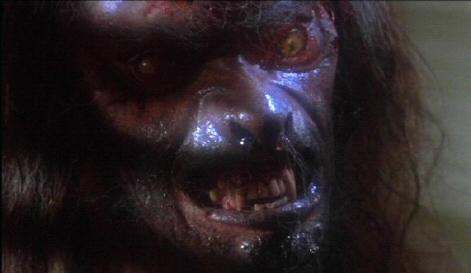
It's fair enough to stack the two movies against each other. Both have a macabre sense of humor and feature sly references to werewolf movie directors and characters. They've both spawned horrible, vaguely-related sequels (the last direct-to-video Howling movie didn't even have any werwolves in it, just lots of poorly-shot country line dancing.) And each features a revolutionary transformation scene from up-and-coming makeup artists; Rick Baker almost left American Werewolf to do The Howling when it looked like Landis' film wasn't coming together, ultimately consulting eventual Howling makeup artist Rob Bottin.
But a problem I've always had with the comparisons is that The Howling is almost always considered second fiddle to Landis' bigger, more popular film, an "also ran." Maybe it's because Howling is more of a classic, straight-forward horror movie. Maybe it's because Landis was at that time a crowd-pleasing hitmaker and The Howling was made by a bunch of Roger Corman guys. Maybe it's just because Werewolf's transformation scene is more of a centerpiece than the shadowy mutation of Robert Picardo's Eddie Quist in Dante's movie. But I'm here to tell you: the opening scene of The Howling is better than even Rick Baker's signature sequence. The writing and direction are better, the jokes are funnier. the scary scenes are more effective. Simply put, The Howling is a better movie. And the fact that the world disagrees (one of my college professors went so far as to call Dante "the poor man's John Landis"!!) has always been an immediate strike against American Werewolf for me. People love it. Even with The Howling out of the equation, I'd say it rivals The Exorcist as the most overrated modern horror film.
Reason for Reassessment:
Well...
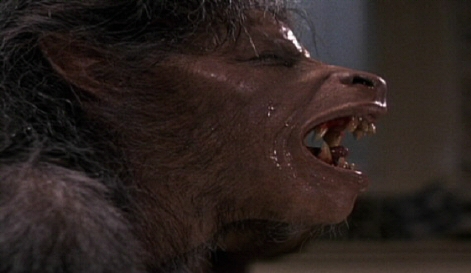
VS.
Of course, it's not exactly fair to use a film's positive reception against it, so part of the reason I decided to give it another shot was to go into it with an impartial mind. Another was to remind myself what I didn't like about it. From memory, I found it difficult to think of specific reasons to hate the movie. All I could focus on were the things I remember being good: Griffin Dunne, the Baker effects, the warped dream sequences. The girl in the movie's good-looking enough, right? Is it possible that I just found this darling of horror fan circles underwhelming? Was the film actually a victim of its reputation? Or have I just been subliminally discrediting Landis all these years for not being an actual horror filmmaker, not wanting to put the director of Three Amigos! on the same level as David Cronenberg or Frank Henenlotter?
If I didn't like the movie, I at least have to figure out why I can't dismiss it entirely. It has at least one iconic scene, which is a hook other overrated horror flicks like Hellraiser, The Blair Witch Project and The Ring certainly don't have. But I can't think of anyone praising anything about the film specifically other than the transformation scene. And personally, I think the 80's produced a more effective transformation scene (Rob Bottin's in The Howling), one I thought was scarier (Stan Winston's in The Monster Squad) and one I found more inventive (the non-Rush Hour Chris Tucker's work in The Company of Wolves). Not that I'm disparaging any of the worthy praise that's been heaped on what is so clearly a visually and conceptually amazing scene - I'm just pointing out that there are other options out there for werewolf transformation scene fetishists. Furthermore, does American Werewolf even have merit beyond that famous sequence? Something else I wanted to find out.
Honestly, I can't decide what's weirder: that I, a card-carrying horror movie fan, refuse to follow suit and heap praise on this movie, or that it continues to have so many defenders when its director has not done anything else worth seeing that couldn't be credited to the talent of young Eddie Murphy (and Kentucky Fried Movie, which can easily be attributed to golden era Jim Abrahams & Zuckers.) Considering that Landis returned to London recently to helm a (so far, badly reviewed) movie version of the Burke and Hare story and Rick Baker recently revisited the werewolf subgenre with Joe Johnston's disappointing update of The Wolfman, these guys are obviously still living in the shadow of this film. It's an important movie, but I'm not sure I can tell you why. Will I be able to by the end of this? One thing's for sure: I was not expecting to like this movie any better.
The Second Chance:
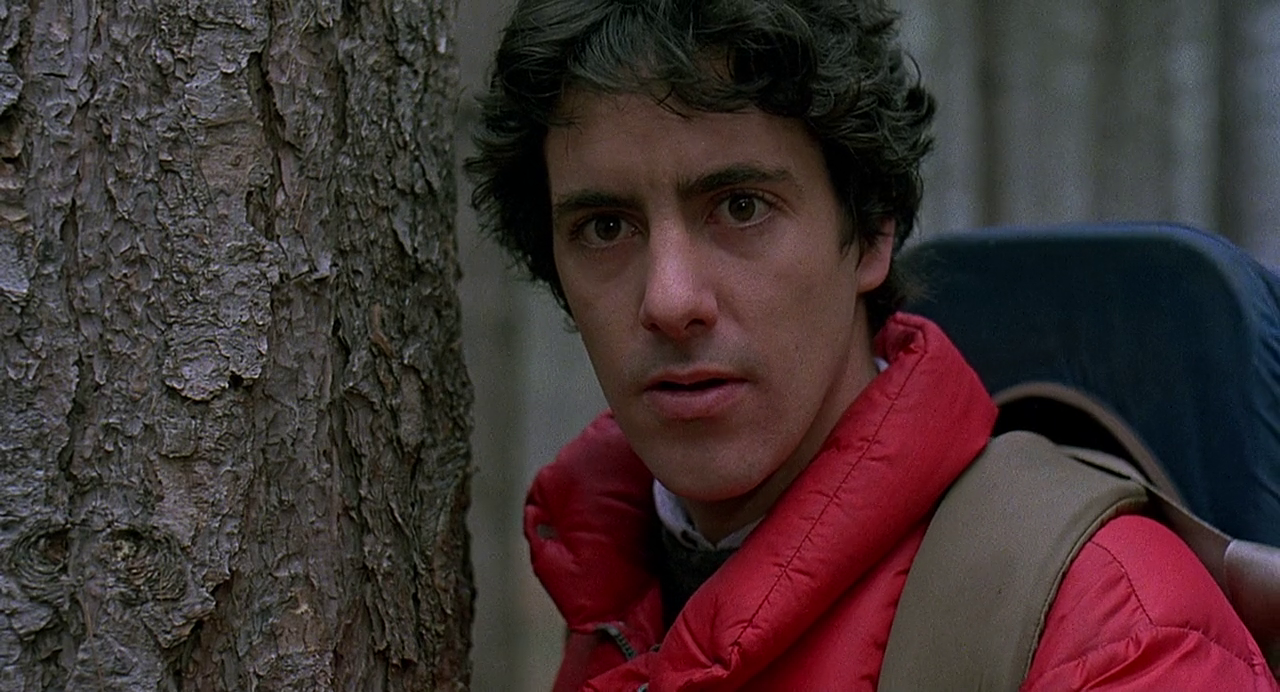
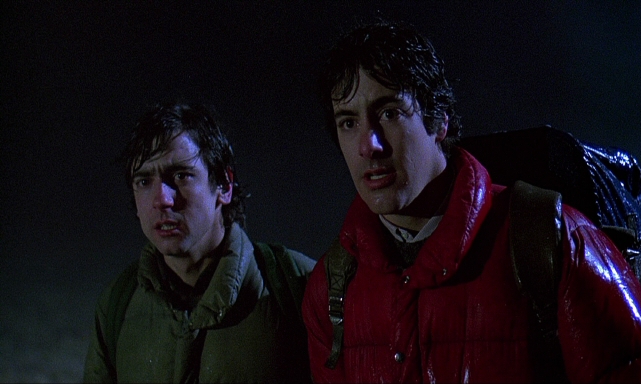
The print screened at the AFI Theater in Silver Springs was first rate: from the opening shots of the mist rising above the sloping Northern England hills I was really impressed by the photography from the usually-bland Robert Paynter (Superman II, European Vacation.) It made me realize that these rural British locations have a lot to do with the film's singularity; its foggy, overcast atmosphere gives the movie an ominous gothic feel that out-Baskervilles the best of Hammer Studios. The visual of David Naughton and Griffin Dunne walking the moors is so memorable - the contrast of those dark green slopes against the American tourists' bright coats, especially Naughton's red padded jacket. Never has a movie opened with characters so nakedly out of their element: these two aren't just Americans lost in Northern England, they're two modern regular joes who've walked into an old monster movie complete with the distant braying of some unseen beast.
It's a great introduction to the characters, having them exiting the back of a truck transporting a herd of sheep, themselves soon to be proverbial lambs to the slaughter. I also like that Landis has his own signature title font like Woody Allen and John Carpenter, whether he's doing a movie like this or Coming to America. And the haunting melody of "Blue Moon" sets the tone. (Has any singer had his songs used more ironically in movies than Bobby Vinton? Between this, "Blue Velvet," and "Mr. Lonely," anyone meeting him today could very well expect Vinton to be some kind of weird ringleader to a band of renegade perverts.)
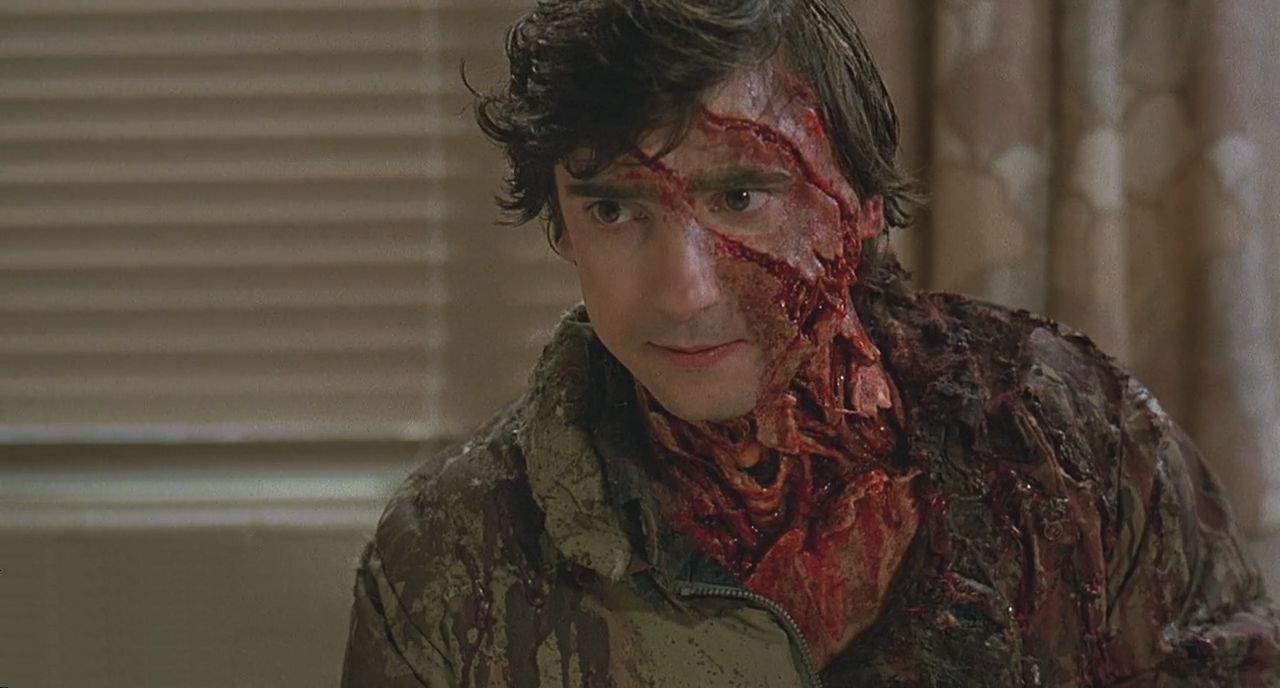
It says a lot going into the movie this time that I remembered Griffin Dunne's character was named Jack, but had no idea what David Naughton's name was (it's, uh, David.) Jack Goodman is a great supporting character: endearing but not obnoxious, funny but not a smart ass, self-effacing without seeming pitiful. He's the ideal American buddy, and the camaraderie between Naughton and Dunne is so natural it doesn't matter that they're not saying anything important. Naughton's relationship with Dunne is the best thing in the movie, and I honestly feel that the film's greatest strengths and most glaring weaknesses come from that fact. Every scene with Dunne, from his "living" sequences to his three returns as a gradually decaying corpse, are fully fleshed out (heh) with amusing dialogue undermining the sad fate of both young men. Every time Dunne appears the film's energy gets refreshed by his presence alone. When he's killed after less than 15 minutes of screen time it's slightly devastating, and Dunne's performance really helps sell the brutality of the largely unseen werewolf attack. He's perfect in the role, touchingly sweet when relating his feelings for Debbie Klein, the girl he pined over who found solace after his funeral in the bed of some asshole. That seems to me an even greater tragedy than David's transformation into a monster, the fact that Jack dies without getting into Debbie's pants: "Life mocks me even in death."
It's in the Slaughtered Lamb pub where the film's first problems arise. Landis is simply too aware of the campiness of a scene where two strangers walk into an archaic setting filled with imposing foreigners. There's little difference between this and the part in Animal House were the white college boys stumble into the all-black roadhouse: there's even that LP-scratching-to-a-halt moment of awkward silence when they enter the pub. Just compare this to the opening of The Howling, with Dee Wallace finding herself in some nightmare area of Los Angeles leading to a seedy porn shop where her growing discomfort at the ogling eyes of patrons builds steadily to her encounter with the serial killer who traumatizes her by literally changing into a beast before her eyes. Dante immediately establishes a world that the characters can inhabit and within which humor can exist; by setting up the joke at the beginning, Landis is establishing a funny world where horrific things are just going to seem out of place in the narrative.
That's the biggest difference between Landis and Dante as storytellers: Dante isn't afraid to make the kind of monster movie he grew up with, whereas Landis seems to feel like he needs to let the audience in on his own appreciation of classic horror films (this is why Dante's inclusion of B-movie snippets in his films always seems natural, whereas Landis' using them in Innocent Blood seems so damned forced, like his aggressive use of horror filmmaker cameos which, fortunately, American Werewolf does not share with his other work.) When faced with the decision to play it straight or ham it up, Landis will ultimately choose to go tongue-in-cheek, which becomes hugely frustrating when there are a number of moments that are naturally eerie, like the great shot where David and Jack unwittingly lose the path.
In one of my Video Oddity articles I rambled on pedantically about the use of comedy in horror movies. American Werewolf is usually described as a horror-comedy, and I just want to get this out of the way: when I hear the term "horror-comedy," I think of a movie that is a parody of horror films or has a larger "comedy" quotient to its "horror" supplements. I think of Young Frankenstein or Saturday the 14th or Transylvania 6-5000 (making me officially the only person who ever thinks about that movie, in my vain attempts to keep the career of Rudy De Luca alive in my head.) Because every good horror movie has a huge amount of humor in it, everything from Texas Chain Saw Massacre to the Hostel series. But nobody refers to those films as "comedies."
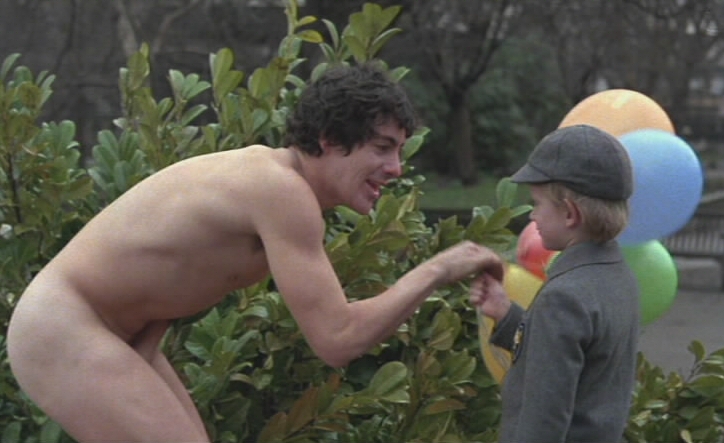
There are some titles, mostly zombie movies like Return of the Living Dead, Night of the Creeps and Shaun of the Dead, that balance their horror and comedy in equal measure (ie, straight monsters and realistic violence despite goofy performances and obvious awareness of source material.) American Werewolf falls into this category*, which, at the end of the day, is "horror movie." In Werewolf, there are two types of comedy going down. The first is the self-aware "goofiness of the situation" comedy, such as the gallows humor delivered by David and Jack (mocking the cliche of the howl coming from the moor late at night or David's jokes about his transformation.) The second is Landis' attempts at gags outside the narrative. While the self-aware comedy is as imbued in the world of the film as that in Re-Animator, an "I can't believe this shit exists in my reality and it's actually happening to me" approach, Landis' gags exist outside the world and do nothing but undermine the story. They fall completely flat when they aren't outright embarrassing. Ooh, David's running around naked at the zoo, let's wring some laughs out of that! Frank Oz and Miss Piggy in the same movie! Get it? It's so madcap! And a bumbling police sergeant who walks into a closed door? Absolutely grating. The only attempt at comedy in a horror film I can think of that's worse is the idiot cops trying to hitch a ride in The Last House on the Left.
But it isn't enough to just say the comedy doesn't work - there's a fundamental problem in the storytelling. It reportedly took Landis 12 years to write the screenplay and it feels like it wasn't quite complete (even Roger Ebert's review opined that the film seemed "curiously unfinished.") Several scenes end abruptly, fruitless subplots appear to exist as padding between the main plot and the writer's bits of whimsy mark moments where Landis can't fully commit to a serious story. Placing the "naked American man stole my balloons" crack after the night of David's murderous rampage doesn't relieve the horror of his situation, it just takes away the emotion of its impact.
In fact the movie's best joke doesn't appear until the ending credits in the form of the text: "Any resemblance to any persons living, dead or undead is coincidental." That's not even a great joke, but at least it doesn't get in the way of anything happening in the movie. Landis' career feels like one big identity crisis - he's directed car chase movies, espionage thrillers, gangster films and horror flicks, all of which either revert to awkward comedy or become so marginalized by the broad humor that only the stupid jokes are left.
Part of this comes from Landis trying to understand youth culture, or urban culture, and more often than not result in flat stereotypes - fine for empty slapstick but completely unrefined. The ironic shot of a Mickey Mouse figure witnessing David's lycanthropy I wouldn't mind letting Landis get away with, if he didn't have such a reputation for aiming for the cheap seats. A lot gets made over the film's similarly ironic use of music, which are like the songs from The Graduate: some of it works, some of it feels forced. Obviously the two uses of "Blue Moon" - in the credits and during the transformation scene - are the ones that work, but the use of Creedence** and Van Morrison feel as cheesy and smart-assy as any employment of this cinematic tactic from Apocalypse Now to the work of Quentin Tarantino.
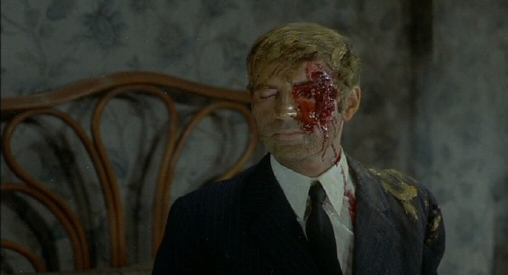
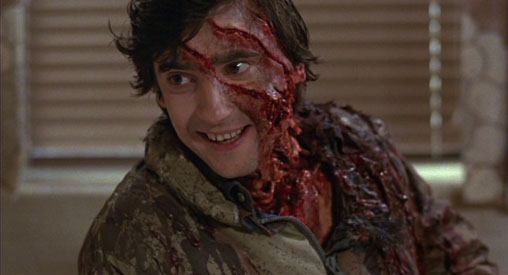
I wouldn't be so harsh on Landis' comedy if the rest of the film didn't have scenes I felt deserved better. The bizarre, comedic feel of the movie itself works very well, and the horrible absurdity of the dream sequences in particular is pitch-perfect. Landis has admitted that the surreal nested dream-within-dream structure was inspired by The Discreet Charm of the Bourgeoisie, but something else he may have borrowed from that movie is the decaying ghost of Jack, so similar to Discreet Charm's mutilated solider. The playful banter between David and a steadily putrefying Jack manage to relieve the sickness of the scene even as it's playing out without detracting from what's going on. Dunne brilliantly delivers what is both the funniest and most unsettling line of the film: "Have you ever talked to a corpse? It's BORING!" (the irony being, of course, that David IS talking to a corpse. What a great line!)
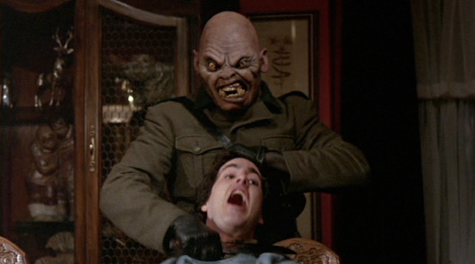
It's in these moments that Landis the filmmaker really wins out over Landis the clown, and they are effortlessly funny. There's a twisted, bemused anarchy to the second nightmare: the wolf-SS officers mowing down mom in her kitchen and the two kids in the living room (same number of children killed in real life on the set of The Twilight Zone.) Landis' use of Nazis in general - Blues Brothers, Twilight Zone - is weirdly uncomfortable and unapologetically irreverent, but making them demonic-looking wolves who break into a scenic American home with machine guns yet use a knife (the instrument of the surrealists!) to slit David's throat is truly inspired. The sheer horrific chaos of the scene is comedic on its own without the use of pratfalls or one-liners and is just one standard wake-in-sweat conclusion removed from being truly Bunuelian. If only Landis could strike this kind of balance in the film's surrounding scenes, I'm convinced American Werewolf would be the masterpiece so many claim it is.
In the real world with no decaying friend or Nazi wolves, David is hopelessly boring. David is not a well-developed character; he's as thin structurally as David Noughton is physically. In the first three scenes we learn more about Jack - he's seen John Wayne's The Alamo, prefers Italy to Northern England, recognizes a pentangle when he sees one, and has been obsessed with Debbie Klein for a long time - than we learn about David throughout the entire film. Again this underdevelopment is even more disappointing in lieu of a later scene, where David calls his folks in Long Island to say goodbye. The phone booth sequence is really the only sense we get of David's life back home, that he's got a family (the same from the nightmare, one assumes) with two younger siblings. It's a genuinely sad scene, beautifully acted by Naughton as he speaks to his little sister across the pond, one that I wish the movie earned.
I don't blame Naughton (whose followup to this was Hot Dog...The Movie) for failing to bring David to life: he's a little bland but gives a decent performance overall and is funny during the freak-out in front of police. It seems like Landis dropping the ball again, when he's set up David to be such an interesting character only to leave him as a kind of blank slate. He works more as a symbol, a young man filled with American brashness struggling with the pangs of responsibility and his own suicidal ideations.
Because at its most poignant, this is a movie about survivor's guilt. David's remorse over running away as his friend was being torn apart is subsequently tearing HIM apart and manifests itself as a literal ghost of said friend, urging him to kill himself. The Nazi nightmare and David's background ("He's a Jew - I've had a look," a nurse confides to another) conjure Holocaust parallels and suggest tongue-in-cheek Jewish guilt over the crucifixion, hence David's almost propitiating blaspheme of "Jesus Christ!" when he begins the torturous transformation. But when the poor development of David as a character is considered, that feels like giving the movie a little too much credit.
If David makes for a weak lead, the rest of the characters are flat-out non-existent. The English policemen handling the case, the doctor who takes a ride in his MGB-GT to investigate the Slaughtered Lamb for no reason: until the last scene there's no need to pay attention to them at all. Then there's Jenny Agutter as nurse Alex, who begins a relationship with David that is neither convincing or realistic. No background is explored for either of them; they certainly don't seem interested in anything beyond their current relationship. It all comes back to David's companionship with Jack, which is so good it makes everything else seem phony. Jack obviously feels closer to his dead friend as evidenced when, writhing in agony, the last thing Naughton does before transforming fully is scream an apology to Jack for calling him a "walking meatloaf."
All that aside, the question is how Landis' film holds up as a good old fashioned monster movie. Again this is an area where the movie falls short next to The Howling. Dante's film, from a script by John Sayles which makes for a more original werewolf concept that doesn't update elements from the classic 1941 template (as well as the lesser known Werewolf of London from 1935), treats its fanged subjects as threatening invaders from the outside. Whereas David's terror comes from within, in The Howling there's a werewolf conspiracy and everyone is against an already traumatized Dee Wallace.
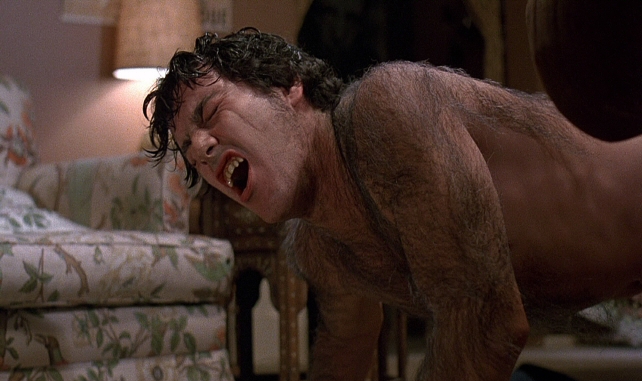
The transformation in AWIL is sexier and more visually arresting, but it's also an interior thing - you can appreciate the horrible, painful changes this poor guy is going through, but since the danger is not in the tradition of the classic "confrontation" with the monster, the danger is never really palpable. This might have something to do with Landis' decision, possibly inspired by his friend Steven Spielberg's Jaws, to show the wolf itself as little as possible outside the transformation scene. Which just isn't as effective as seeing them in full under Rob Bottin's supervision.
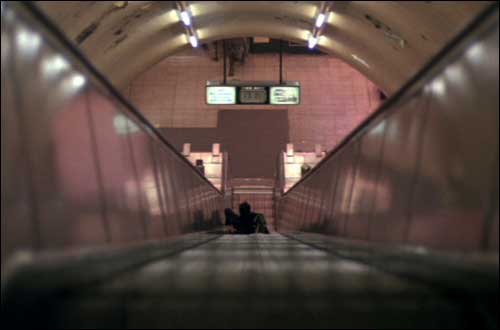
The one decent suspense piece in American Werewolf, where an anonymous victim is chased through the tunnels of the tube culminating in that great shot from the top of the escalator where the wolf just barely comes into frame, is cheapened by the other more mediocre moments of werewolf mania and the sloppy final scene - the finale at Piccadilly Circle that might as well be one of the big car pileups from The Blues Brothers it's so slippery and chaotic. Landis seems to pull away from the thrills either out of a fear at his inability to direct these kind of scenes or an unwillingness to let the movie "revel in its trashiness," as Pauline Kael stated in her review of The Howling. If David were a better character the internal struggle would be more compelling; as it is there is no satisfying exterior conflict that The Howling delivers so easily. This actually makes the movies so different that I now realize comparing them is inherently stupid...like comparing The Texas Chain Saw Massacre to Texas Chainsaw Massacre 2.
That said, I will point out the only scene that comes close to the creepiness of the porn shop opening of The Howling - the penultimate episode in an adult movie theater. It's another encounter with Jack, as well as the other (in some cases, literally) faceless victims of David's nocturnal activities. It's our last moment with the two men, and it's a nice gesture when Naughton says, "I'm glad to see you, Jack," even though his friend has now rotted beyond recognition (Dunne still does a great job, even through the proxy of a puppet standing in for him.) The victims - some bitter, some polite - suggest ways David can kill himself and thus end the cycle. In the movie's defense, it doesn't end with either obvious option of having the David-wolf regain enough of his true self long enough to hurl himself off a rooftop or a dumb twist revealing that Alex has been scratched and contaminated by him after he's dead. But... it just ends.
Like many a scene before it, the interesting and intimate conversation in the theater randomly halts with the victims still arguing as David changes and runs amok only to be shot dead by a cop outside the building. So what has everything been building to? Maybe Landis should have considered one of the obvious ideas for an ending in favor of the one that reminds me of . It's abrupt and arbitrary, undercutting everything that came before it in the five minutes it burns up until the film cuts to black.
I'm not sure what the hell happened here. In some ways I've completely come around on the film; on the other hand I feel more frustrated with it than ever. I guess the easiest way to break it down is to say there are things that work (Dunne's character and performance, the make-up effects, the dream sequences) and things that don't (the story, the comedy, all the other characters.) Which is exactly what I said at the start of this thing! But that's really what it comes down to: I love the good stuff and hate hate hate the bad. But seeing it again, I now understand that the good stuff really is super - enough so that I ended up picking up the cheap Blu-Ray disc as my annual October horror movie purchase. And what the hell is this movie's relationship to Warren Zevon's "Werewolves of London" anyway? Not a single piña colada is consumed over the course of the entire film.
Thanks everybody, have a safe and fun Halloween. See you next Wednesday!
~ OCTOBER 29, 2013 ~
* I truly hate labeling films by genre, but in this case I feel it's important.
** Interestingly, I thought "Bad Moon Rising" was much more prominent in the movie than it was. I guess I just associate Landis with CCR because of the bookends he directed for the Twilight Zone movie (the ones where all the actors survived the production.)