frustrating
FiLMOGRAPHiES
john cribbs
An on-going series dedicated to great directors... great directors who've transgressed. Disappointed. Befuddled. But not bumbled so badly as to deserve being written off entirely.
Frustrating Filmographies explores these great filmmakers' most baffling slip-ups and tries figure out what their motivation might have been in choosing projects that proved questionable, wrongheaded or outright embarrassing. The purpose of this experiment is not to deride the greats for stumbling, but to understand how they ending up taking a faceplant.
the subject: WES CRAVEN.
the movie:
MUSiC OF THE HEART.
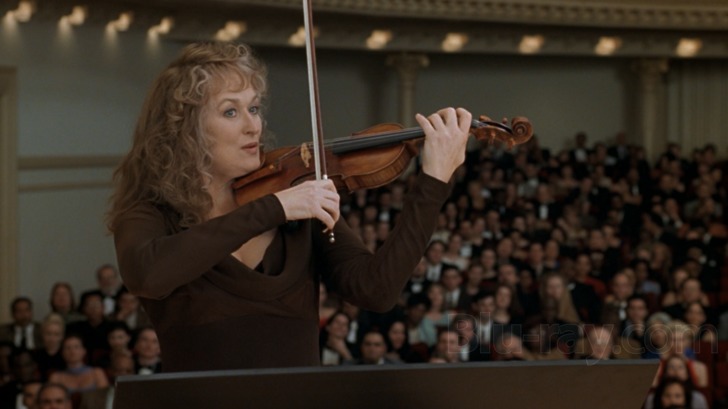
It was exactly 10 years ago this very date – October 29, 1999, a cold, depraved introduction to the Halloween weekend – that an ungodly terror was released upon an unsuspecting world. The bows of hell were raised, the strings of terror were plucked, and a group of precocious inner-city kids learned the meaning of music and of life in the heartwarming Miramax production Music of the Heart.
Hey wait a minute – what the hell? John you promised us a week of horror movies! Now you're reviewing some teacher-inspiring-inner-city-school kids Meryl Streep violin-playin Hollywood bullshit? Hey don't blame me. Blame Mr. Wes Craven, the subject of this week's very scary "Frustrating Filmographies."
Craven, of course, is the iconic director behind such modern horror classics as Last House on the Left and The Hills Have Eyes. He's best known as the creator of dream serial killer Freddy Kruger from the seven-film Nightmare on Elm Street series, of which he directed the bookend chapters. With a well-established reputation as a master of modern horror (like John Carpenter, he saw various movies released with the possessive "Wes Craven's" tag above the title) he managed to reach a new generation of fans by helming Kevin Williamson's Scream movies, the first of which was released in 1996. And although that trilogy's self-aware, post-modern take on scary movies and the "slasher formula" revitalized the popularity of a genre that had been more or less relegated to video store distribution in the course of that terrible decade, their snarky satirical tone and rampant in-jokes were a far cry from the genuinely disturbing thrills of the director's earlier work. Then came Music of the Heart.
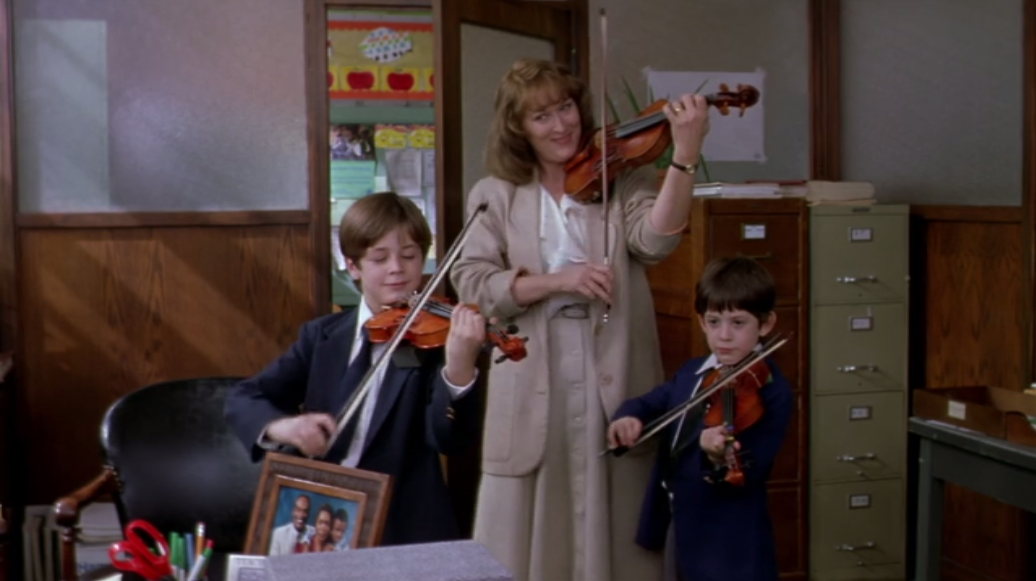
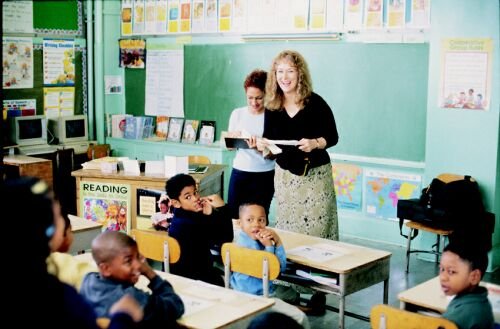
Music of the Heart is the enriching tale of a recently-separated mother of two who lands a job teaching the violin to students at an East Harlem elementary school. She helps the kids learn to appreciate the beauty and power of music until one day she wanders into the basement looking for a music stand or something and discovers a horde of mutant creatures living under the school's foundation, products of an incestuous relationship between the principal and the janitor! The mutants escape and terrorize the campus, mauling and munching on students and faculty alike. The teacher and her remaining pupils are forced to fall back on their primal survival instincts until someone realizes the power of their violin-playing can lull the rampaging monsters back to their resting place. They trick the creatures into a beautifully-scored, hypnotizing march back to the basement and seal the entrance forever, but an eerie light beneath the door suggests this is far from over. There will probably be a sequel, possibly featuring a dog POV.
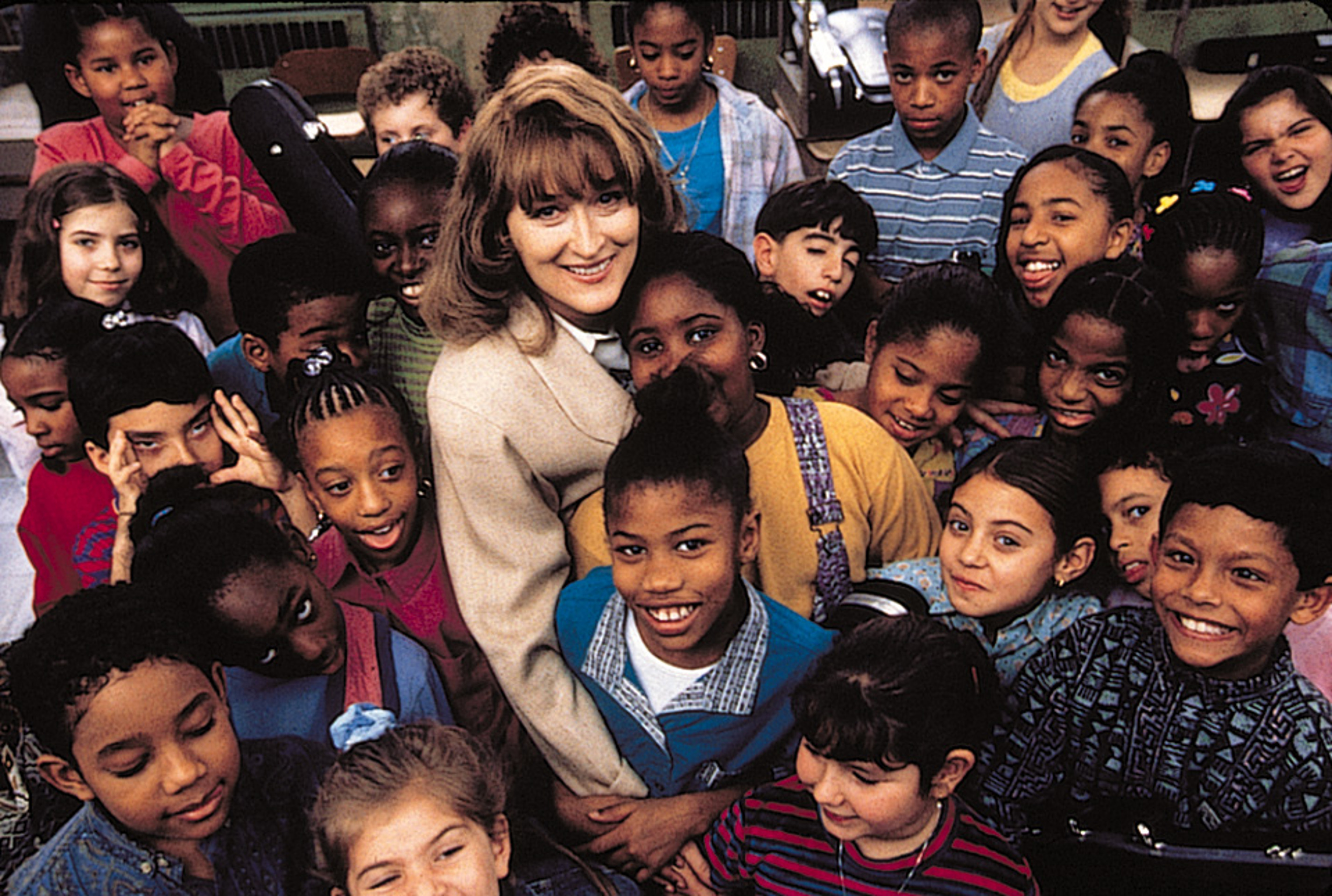
Ok, technically only the first sentence of that summary accurately describes the final cut of the movie (after several script changes no doubt). There are no underground abominations, only the open hearts and minds of doe-eyed children eager to be motivated to greatness! Like Last House on the Left, the film has a lot of alternative titles – well actually just two, 50 Violins and Fiddlefest; the teacher starts her first class using 50 violins she purchased in Greece and ends up holding a fundraising concert called "Fiddlefest" at Carnegie Hall when the school board threatens to eliminate her program due to budget cuts. Those titles, and the film, are inspired by the true story of Roberta Guaspari, founder of the Opus 118 Harlem School of Music and subject of the independent 1995 documentary Small Wonders. Small Wonders was bought and released by Miramax, and touted as "the real Mr. Holland's Opus," which leads me to question what Music of the Heart would be considered. The fake Small Wonders? A female version of Mr. Holland's Opus? Or some deformed patchwork beast made up of the two films, one that has to be brought down in a hail of bullets once it starts rampaging, relentlessly spreading its positive messages all over town?
Mr. Holland's Opus was roundly ridiculed in 1995 for being not only an overly sentimental story about an Inspirational Teacher à la Dead Poets Society, but also being an overly sentimental story about an Inspirational Musician (think: Shine, The Soloist), thus effectively combining the two hokiest of subgenres. The script for Music of the Heart takes that one step further by portraying a character who is both an Inspirational Musician and the Inspirational Teacher to Underprivileged Kids, a character based on a real person. Hollywood had already tapped the Underprivileged, Inner-city Kid well with films like Stand and Deliver, Lean on Me and Dangerous Minds, but in their desperation to recapture the Oscar glory of the previous year the Weinstein brothers wolfed down the Small Wonders documentary and regurgitated it as an award-baiting story of one woman's struggle to awaken the beauty in the souls of her students and, ultimately, herself. The only thing left was who to hire as director, a decision that must have been made like this: "We're looking at a release Halloween weekend. Whose films usually do pretty well around that time?"
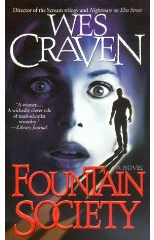 Well, technically that's not what happened. Craven allegedly informed the Weinsteins he'd only direct the next Scream movie if he was allowed to do this one first. His ultimatum isn't actually that shocking: he had obviously been trying to distance himself from the genre since the mid-90's. Before Scream he made Vampire in Brooklyn, an Eddie Murphy vehicle that attempted to transition from horror to comedy and ended up failing in both departments. The Scream movies themselves, aside from having a deliberate playfulness to them, have a detached feel that suggests the once straight-faced horror auteur was purposely indulging in self-parody. And 1999, the same year of Heart's debut, saw the release of Craven's novel Fountain Society, a thriller about cloning and government conspiracies that reads more like an "X-Files" episode than a Stephen King book. Still, no fan of Craven's saw Music of the Heart coming. It wasn't just a departure: it was as perplexing a move as if Penny Marshall had announced her next project would be a Hellraiser sequel. Not only was it a departure from the genre he was known for revolutionizing, it dealt with a subject as removed from Craven's previous work as Anne Ramsey's head was from her body in the memorable basketball sequence in Deadly Friend.
Madonna was the original star to spearhead this vanity project but was Swept Away, citing "creative differences," so Craven and the Weinsteins went with The Next Best Thing and cast Meryl Streep, the mascot for overrated actors. It was a brave thing for Streep to do
I don't know why, but that's the kind of thing all those Actor's Studio types are always telling her so why not. By the way from here on I'm going to be referring to the character as "Meryl" rather than "Roberta" because when Meryl Streep acts I don't see a character, only Meryl Streep.
Her character in the film is an amalgam of various types from those previously mentioned movies. She's got the irreverently harsh manner/tough love approach of Morgan Freeman in Lean on Me, she's the same kind of influential yet flawed educator as Mr. Holland and lovable fish-out-of-water as Whoopi Goldberg in Sister Act 2. The kids initially reject her approach (sort of – more on that later) then eventually stand up for her when she's about to be lose her job, just like the members of Dead Poets Society. In other words she's as standard as this kind of character comes, a cut and paste job with one huge, original twist on the formula
she plays the violin!
"How do you expect to reach these kids?"
"With
this!"
"A violin? You must be crazy to think a violin can serve as a portal to the untapped potential of these disadvantaged kids! Crazy, I say!"
That's not exact dialogue from the movie but it's fairly representative of the first thirty minutes or so, with variations on the same theme repeated throughout the first hour. The rest of the cast is made up of one-dimensional characters either in support or opposition of her crazy-teacher ways. Gloria Estefan, whose most impressive film credit up to that time was having one of Miami Sound Machine's songs on the Cobra soundtrack, makes her acting debut as one of the pro-nutty violin teacher staff members. Playing the best friend with ostensibly one scene worth of dialogue didn't inspire her to pursue further filmwork – she hasn't appeared in a feature since (but it's only been ten years, maybe she's holding out for the right project). Angela Bassett, appearing as the principal who's on the fence about all this violin business, claims on the DVD documentary that she's worked with Craven "twice" before, but so far as I can tell he's only directed her in Vampire in Brooklyn. She was in Innocent Blood – is she confusing him with John Landis? Or Critters 4 director Rupert Harvey? Does she think Craven directed How Stella Got Her Groove Back? * Anyway Bassett plays the part like an angry chief in a cop movie, constantly telling Streep "get in my office!" and reading her the riot act for her showboating, maverick teacher antics. And Cloris Leachman pops up now and then as the sassy, casually racist grandma who tells it like it is.
The movie's chief antagonist is an envious colleague who doesn't cotton to Meryl's violin-teachin' agenda, played with cartoonish smugness by John Pais (voice of Raphael from the first Teenage Mutant Ninja Turtles movie). He must not have had an inspirational violin teacher growing up because he's a little bitter and surly. As literally the only consistent personified force of contention Meryl runs into, he exists solely to be ridiculous (in the commentary Craven states that the character's not based on any person living or dead). Craven can't do comedy: focusing on the bumbling sheriff and deputy in Last House and turning Freddy into a smartass one-liner over the course of the Elm Street movies are admitted mistakes of his (the latter he corrected by making Freddy scary again in New Nightmare). But this character goes beyond bad comic relief, appearing in the movie so it can say "Look at this moron everybody – this is the just the type of guy who would be against the kind of revolutionary teaching fundamentals Meryl's presence at the school represents. What a boob!" But of course his unmotivated desire to see her crushed and humiliated goes unrealized, and Meryl continues bringing her fiddlin' fundamentals to class to the apparent benefit of these wayward adolescents.
Rosalyn Coleman gets the part of Token Angry Black Mom who removes her son from the class, explaining to Meryl in no uncertain terms that she doesn't want some lady teaching her son "dead white man's music." Meryl informs her that the kids are only learning to play "Twinkle Twinkle Little Star," what's the big deal? Yet only a few classes in and they’re already reciting Bach! Sure enough, when the son returns ten years later to support Meryl in her time of need, he's turned into the preppiest, most GQ-looking black man ever to come out of Harlem, complete with sweater vest. One of the themes of Craven's earlier films is that an assault by unfeeling, primal forces can awaken similar primal instincts in ordinary people, either out of retribution or pure survival instinct. What's more horrific: a group of murderous rapists and cannibals transforming boring, middle class folks into bareknuckle avengers who'll do anything to protect their family, or a white woman in East Harlem turning black kids into conservative yuppies?
Not that I'd ever accuse the movie of suggesting that the pinnacle of a young black man's success would be to become a successful white man. This movie's hip, yo – it opens with an Aaliyah song! It has black movie friends, like Waiting to Exhale. It knows what's up.
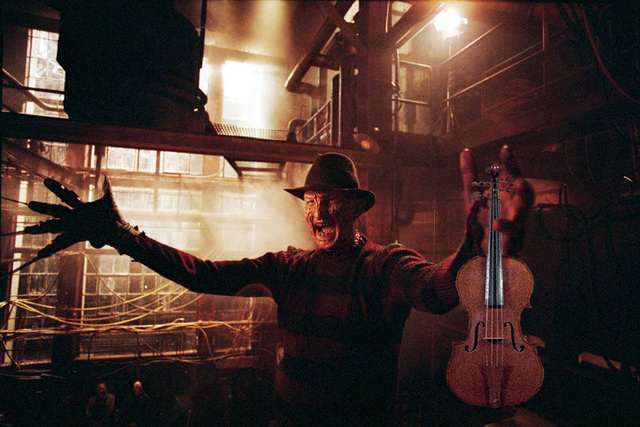
I guess Coleman realizes this because she soon warms up to Streep and things are going well when the movie cuts to ten years in the future.** Meryl's hair is a little grayer, she sometimes remembers to walk a little slower and she now has a Culkin kid, but looks as old as she did at the beginning of the movie. Apparently Craven can hire people to make it look like Robert Englund was burned alive inside a boiler room, but not to make Meryl Streep look any younger.
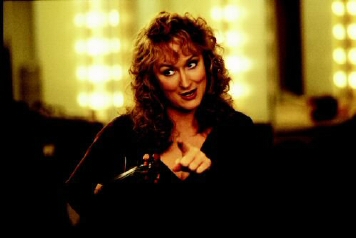
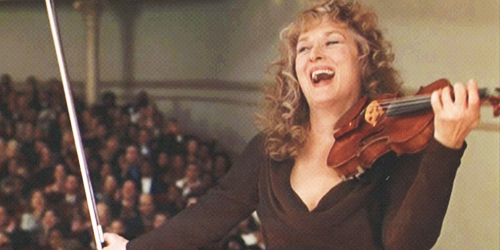
To make a very long story (over two hours!) short, budget cuts threaten to eliminate Meryl's violin class and her job, Chief Bassett has her hands tied, so supportive friends, teachers and boyfriends come together and arrange the fundraising "Fiddle Fest," where current and former students play with such luminary violinists as Itzhak Perlman and Isaac Stern (very famous.) Everybody loves it, there's a shot of the John Pais character in the audience crying because he finally believes in this crazy violin teacher. Backstage at Carnegie Hall, Meryl gives the troops a pep talk: "I want you all to take a second and just... breathe. Deep breaths. Now listen to me. I want you all to play from your heart. Forget about the audience, watch me, you'll do just fine. Just play from here." On the commentary, Craven reveals that Streep made up the line on set and her brilliant improvising inspired the title to be changed from 50 Violins to Music of the Heart. Just like how Last House on the Left was retitled from Sex Crime of the Century – make it more universal.
This "heart" business would be a deal breaker for me if I were actually invested at all in the movie or the character. Meryl's whole deal is that she teaches the children commitment and discipline by having them dedicate themselves to perfecting a difficult musical instrument, fine. But that's a mind exercise, the same kind learning to do literally anything would require: learning to ride a bike, or throw a football, or fix cars. The implication of musical spirituality that comes "from the heart" is entirely besides the point to what this thing is supposed to be about - it's a concept that is completely forced on the narrative and has nothing to do with anything. Putting kids through such a conformative process as being part of a violin group, having them concentrate on doing the same thing over and over, is not instilling in them some kind of poetic insight, even if it somehow inspires some of the kids to become better people (with sweater vests). They're giving themselves over to hours of difficult rehearsing and taking time away from other potential activities (the movie implies that said activities would be negative ones, running with gangs or smokin' crack, but there's every possibility that positive opportunities are also being missed), only to be told that Meryl has imbued them with some magical transcending purpose in life. It's an ignorant way to think, and arrogant.
If that's not a convincing enough argument that this movie has an ego the size of an octobass [that's the biggest kind of bowed string instrument - funderburg], check out the film's tagline: "She gave them a gift they could never imagine. They gave the system a fight it would never forget." Not as good, in my opinion, as "To avoid fainting, keep repeating: It's only a movie...It's only a movie...It's only a movie..." or even "Don't bury me – I'm not dead!" My question is, DO they fight "the system?" Nobody in the film really represents the system. This movie fails to include an Andy Garcia-in-Stand and Deliver bad guy come to rain on everyone's parade, so who exactly is in danger of forgetting this alleged fight that never happened? The only idea of some higher power looming over the school looking to undermine the fabrics of public education is through Meryl's angrily rants in front of family, students and in introductions to concerts that practically make her sound like a conspiracy nut. I got the feeling, from the film, that her attempts to "save the music" were not so much based on benefiting the kids as to keep herself from being unemployed. Wanting to save your job is absolutely reasonable, but masking that motivation under the pretext of "the children are our greatest resource" philosophy is a little dodgy. I'm sure the actual Roberta Guaspari's actions were more momentous in real life but as portrayed in the film it's got all the gravitas and significance of Max Fischer saving Latin.
This kind of sentimentality doesn't become Craven, whose reputation is based on his earlier work's brutally honest portrayal of violence (Last House was a Vietnam parable, for instance) and his later slasher fare's reflection of the same. My take on Craven, which I've brought up a couple times in the past and still believe, is that he has absolutely great ideas which suffer from terrible execution. There's always something about his films that doesn't work: the terrible comedy and generally shabby filmmaking in Last House on the Left, the half-thought out "mutants" of the original Hills Have Eyes, the entirety of the movie Shocker [except for the last ten minutes! - funderburg]. But at the same time his films are smart, which makes me wonder why the hell he'd find himself involved with anything so dumb as Music of the Heart.
Craven is unabashedly proud of the film, as evidenced on the DVD commentary.*** He starts the commentary track with producer Marianne Maddalena, who for some reason stops talking entirely ten minutes into the film. (Did she fall asleep? I hope Freddy didn't get her). "I was dying to do a picture outside of the genre," Craven confesses, seemingly obliterating all ambiguity over his main reason for doing M.O.T.H. "This is one of those movies of love that I've been waiting years and years and years to be able to do." Well that explains everything except what it was that could have possibly appealed to him about an inspirational script involving a violin teacher who plays by her own rules .
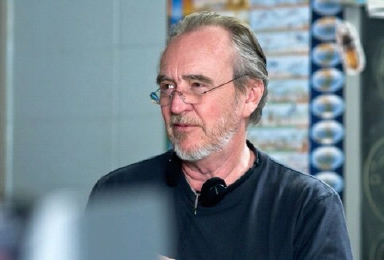
In his review of Music, Roger Ebert described Craven as "a cultured man who broke into movies doing horror and got stuck in the genre; he's been trying to fight his way free from studio typecasting for 20 years." Well, that's completely legit. If a director wants to break typecasting, or even challenge himself with material outside his comfort zone, that’s absolutely fine. But let's face it Wes, this is unacceptable. Munch never turned to positivism. Gyorgy Ligeti didn't write marching songs. There's a big difference between branching out and directng something that doesn't even exist within the boundaries of your own work, let alone an unapologetically cheesy Inspirational Teacher movie in which Meryl Streep at one point tells a crippled kid "you can stand strong on the inside."
Several filmmakers commonly categorized as "horror directors" have tried their hand at something different. There have been successful attempts, like George A Romero's Knightriders, and less successful attempts that resulted in Dario Argento's Five Days in Milan and David Cronenberg's Fast Company. But those two failures in particular can be described as early slips by young directors still trying their voice, Craven was well into his career when he accepted this project. And for his part, Cronenberg is a filmmaker whose early films are textbook genre pics while his later work evolved into something absolutely unclassifiable; yet somewhat improbably, his whole filmography feels intrinsically connected. Couldn't Craven have found a non-horror project with themes that reflected his movies up to that point? Or has he been personally repulsed by the films he makes, secretly hoping that one day the right kind of safe, by-the-numbers Hollywood melodrama would come along?
As far as bearing the inescapable brand of "horror director," well fiddle me this, Craven – how come Sam Raimi wasn't compromised into making an Inspirational Teacher movie with Meryl Streep? You could argue that Raimi's guilty of shelling out a Nostalgic Sports Movie with Kevin Costner, but that's a perfectly legitimate side project for a baseball fan like Raimi, especially when your next project is something as good as A Simple Plan. How about Francis Ford Coppola and Joe Dante and other Corman protégées who started their careers with horror movies but moved on to other things? Steven Spielberg did Duel! Universally well-respected directors have managed to step in and out of the horror genre without being "trapped" by it, and come up with some of their best work: Neil Jordan, William Friedkin, Stanley Kubrick, Roman Polanski
John Carpenter! Carpenter, the only man who I think rivals Wes Craven's influence and consistent contributions to the genre over the last four decades, has made amazing films that would never be considered "horror" by anybody (Assault on Precinct 13, Escape from New York, Big Trouble in Little China) yet reflect the filmmaker's style and interests and, most importantly, are anything but standard.
Craven should have taken a look at the career of Friday the 13th series veteran Steve Miner, whose non-horror projects include such fecal matter as Soul Man, Forever Young and Wild Hearts Can't Be Broken. These aren't the films of a respected filmmaker, they're soulless studio products brought in on time and on budget by a layman director. Granted, Miner's not nearly as talented or interesting a horror director as Craven, but that doesn't mean Wes could take a boring movie with cut-and-paste plot and bring anything to it. I'm tempted to just give up right now and blame this on straight-up senility; that reverting to a broader, more popularly-accepted genre at age 60 was just Craven's version of purchasing a midlife crisis dick car.
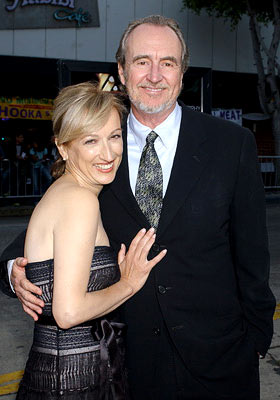 But Wes Craven is an intelligent guy. And a former college professor! He knows about all the stuff his fellow horror directors have done, and he's thought about it – I guarantee it. And that’s why I can't accept his excuse of "dying" to make a non-horror film. I don't buy that the creator of a franchise as successful as the Nightmare on Elm Street movies would have such a hard time breaking out of the mold, or that he got so old he didn't realize the blatant lack of sophistication inherent in this kind of story.
Maybe there was some personal connection he felt with the material? Let's explore that. He tried his hand at music before his filmmaking career started, appearing in Chicago cabarets with a guitar on his lap. Perhaps he feels an affinity towards string instruments. M.O.T.H.'s broken home subplot, there could be something there. Craven's parents divorced when he was very young, he himself went through a divorce with kids (in his book American Rhapsody, Joe Eszterhas claimed the divorce was a result of Craven's affair with Sharon Stone on the set of his film Deadly Blessing.) Superficially these aspects of the director's life could have drawn him to the material, but the guitar’s not a violin and I can't believe experiencing a divorce would bring him in touch with the female side of a difficult separation (which is just over-dramatized filler in the movie anyway.) Still, you could argue that Craven's filmography is full of strong women (A Nightmare on Elm Street, Deadly Friend - Kristy Swanson being physically strong in that one) and female victimization (Last House on the Left, Scream). It's possible he sympathized with Meryl's role as a struggling single mom. On the other hand, he already tackled the single mom bit in what I consider his best movie, New Nightmare, and it came off with a lot more honesty there.
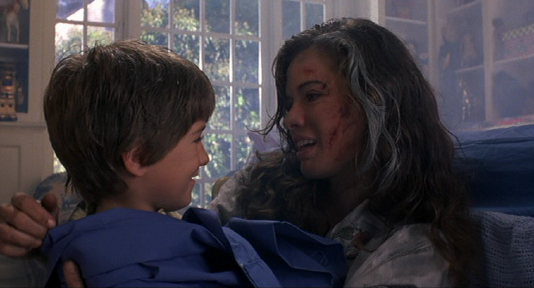
Just consider this: in New Nightmare, Heather Lagenkamp, playing a fictional version of herself, is widowed after her husband dies in a tragic car "accident," of which she witnesses the horrific conclusion. In my opinion that's much worse than dealing with a douchebag ex who ran away with your best friend, which Streep suffers through like a modern martyr in the first half of Music. In Nightmare, Heather can't even mourn her late husband without Freddy showing up to fuck up the funeral. Then she has to deal with a son who's having a psychotic breakdown, a doctor who thinks she’s insane, a pretentious artist version of Robert Englund, a brutally murdered babysitter and a giant Freddy dangling her child over oncoming traffic! I think one of Meryl's kids tells her to shut up at one point while they're having a fight, but neither of them tape knives to their fingers and sulk around the apartment making ominous growling noises. Just watch poor Heather desperately try to keep her son from falling asleep for fear that he won't wake up and then try to feel bad for Meryl when she might have to find a new job. Honestly, what's the appeal to a mother like this?
(Not to mention the fact that, playing an actress famous for a role in a horror film and therefore certain to be shunned for life from all prestigious award nominations, Heather – the character, although Lagenkamp playing herself is more impressive acting-wise than Streep in anything she's ever done – is humble and realistic. Unlike Meryl Streep who, by sheer fact that she is the perpetually phony, award-hording mother hen of Hollywood, comes off as icy and condescending in any role she plays. But we'll come back to that).
I won't even get into the character of Doug from The Hills Have Eyes, who no sooner has been widowed after his wife is murdered by mutated mountainfolk than he's forced to exercise his single parent duties by rescuing his kidnapped baby from said mutants. What's worse, struggling to raise and support your kids in Harlem or trying to stop your baby from being eaten by savage cannibals?
Obviously, it's taken for granted that the seventh entry in a series about a demonic nightmare child murderer couldn't possibly be as true a portrait of a struggling single mother than an inspirational true story starring Meryl Streep. But did Craven himself, looking back at life in his twilight years, start feel a tinge of regret over his exploitation of clueless teen victims in the Elm Street series? Is Freddy not a good enough role model?
The thing is, Craven's direction of M.O.T.H. – and his storytelling – feels hugely self-conscious. He seems to be aware of the Inspirational Teacher movie clichés and veers away from them, something you'd think would be a good move. But with this kind of formulaic story, leaving those elements out just throws the whole thing off balance. Take the initial conflict that one could expect from this kind of movie: inner-city kids have zero interest in learning to play violin. You'd expect it would be the teacher’s first big hurdle. Sure enough, one of the black kids in the first class announces "Violins are for wimps!" forcing Meryl to assure him that violins are in fact "cool." By the next scene, the kid seems to have come over completely to her way of thinking and turns out ten years later to have become a professional violinist. She literally doesn't meet any hostility from a single student (except one who complains to her parents that teacher is too mean) for the rest of the movie. Apparently, this posse does do homework.
Craven is normally a good storyteller, he understands conflict. Like the rising tension between Bill Pullman and Baby Doc's police in The Serpent and the Rainbow that ends with a ten-penny nail being hammered into his scrotum. The man knows conflict.
Speaking of Serpent, remember how interesting Haiti was in that film? Craven actually shot on the island. His settings are usually pretty memorable, from the row of Springwood, Ohio houses lined up for the slaughter in A Nightmare on Elm Street to the Los Angeles ghetto in The People Under the Stairs. But here, even shot by the usually-great cinematographer Peter Demings, the city is just a background to uninteresting events. It's almost as if Craven was worried about playing up the "urban" angle to the story: after a rote ride in a taxi cab with shots out the windows of run-down buildings and dodgy street dwellers complete with cabbie chirping "Welcome ta East Harlem!," the film stays pretty much confined to the school and apartment sets. In his worry to make the city not look ridiculously dangerous, Craven tamed it into a complete non-entity.
There are a few other examples of avoiding the standard practice of Urban School drama that only make the story confusing. Like in Dead Poets Society (and Dangerous Minds, for all I know, and certainly in The Substitute) a classmate dies tragically, in this case it's a drive-by shooting (remember, Harlem). But I'm pretty sure it’s just some random kid who's never pointed out specifically, it might not even be a boy from Meryl's class. Honestly, I have no idea: the only recognizable student characters we remember are because of a physical trait (black, handicapped), not because any of them are well-developed. Again I have to ask: did Wes avoid creating "urban kid" characters out of fear of stereotyping them?
Whether Wes was considered more of a whore for reaping the profits of the exploitation market for twenty plus years or for selling out to make his Miramax Message Movie, the numbers speak for which pimp owns the street. Whereas 1972's Last House on the Left turned $50,000 into $10 million internationally for its investors, 1999's Music of the Heart made back a mere $15 million of its $27 million price tag. The film's failure didn't stop studios from churning out more Inspirational Mentor/Underprivileged Can-Do Pupil movies in the following decade (Coach Carter, Freedom Writers, Akeelah and the Bee) but it paled in comparison to the success of the horror film released the same day, a remake of William Castle's The House on Haunted Hill which would go on to do nearly $41 million from a $19 million budget.
Despite the film's financial letdown, it brought Miramax the attention at award time Harvey and Bob were undoubtedly after. Playing an inspirational teacher had scored an Oscar nod for Edward James Olmos in Stand and Deliver as well as Richard Dreyfuss in Mr. Holland's Opus, a 1991 Image Award for Best Actor for Morgan Freeman in Lean on Me and a Blockbuster Entertainment Award win and MTV Award nomination for Michelle Pfeiffer in Dangerous Minds. Peter Donat won an Oscar and Peter O'Toole was nominated for playing the same celebrated teacher in both versions of Goodbye, Mr. Chips, respectively. Robin Williams was recognized for his desk-climbing in DPS and would later win for his slight variation as "inspirational psychologist" in Good Will Hunting. This kind of role is Oscar Spanish fly: Meryl Streep would have signed on if Harmony Korine was directing. She had already emasculated the terrific director Carl Franklin by getting him to helm One True Thing, her successful Oscar bid from the year before, and probably thought she was doing him, and Craven, a big favor. At this point in her career "actress" seems almost secondary to "award monger."
Still, it's absurd that the Academy went for such obvious bait. The conversation must have sounded something like:
"What about Meryl? What was Meryl in this year?"
"Inspirational inner-city school violin teacher movie directed by –"
"Stop right there. You had me at inspirational!"
What more proof do you need that the Oscars ruin movies than to look at movies like this, or Sidney Lumet's The Morning After featuring an Oscar-nominated performance from Jane Fonda?
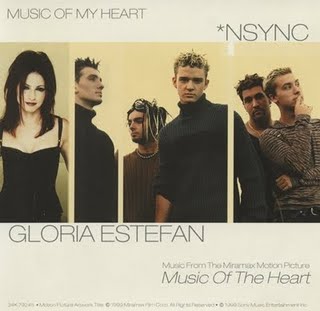
Also nominated for an Academy Award (and a Grammy!) was the eponymous song from the closing credits written by Diane Warren and performed by Estefan with N Sync. Gloria and the guys implore the subject of the song to "Help me to free the me inside," and claim they "opened the door to something I've never known before." (i.e., thanks for teaching us how to play violin, we hadn't done that until now.) But there was that little violin player inside, just waiting to get out. Would they have been as inspired, I wonder, if Streep taught the tuba? Oboe? A different string instrument like the harpsichord?
Ironically, 1999 was the same year the first real film that could be considered "horror" was nominated for five major Oscars: M. Night Shyamalan's The Sixth Sense was up for Best Picture, Director, two acting awards and Best Original Screenplay. And of course it was a mammoth hit, bringing in $293,500,000 domestically, $672,800,000 internationally off $40 million. Harvey Weinstein had blown his chance to finance it after ostracizing Shyamalan on his last film, but at least he had his little violin movie.
Music of the Heart is dedicated "to anyone who's ever been told their dreams are out of reach." Did people honestly tell Craven he'd never be allowed to make a movie about an Inspirational Violin Teacher? Did this movie help him free the "me" inside? Most people looked at Wes Craven directing this movie as a novelty, but it's really just incredibly embarrassing. I'll reiterate that it's one thing to want to do something different and another to do something that's just definitively stupid. So here's my final theory: he didn't threaten not to do Scream 3. The Weinsteins refused to let him do Scream 3 unless he made this mockery of a Message Movie, figuring the gimmick would pay off. Of course it didn't, and everyone went their separate ways (but only after Wes was forced to tell a series of lies about really wanting to do this picture more than anything in the world to save face.)
These days Craven seems to be fine with churning out the same old stuff, producing remakes of The Hills Have Eyes parts 1 and 2 and Last House on the Left (next year sees Platinum Dunes' revival of the Nightmare series, which Craven has nothing to do with it). And today, as I finished writing this, it's been announced that Wes Craven has officially signed on to Scream 4 along with old pal Kevin Williamson. So either you believe his story and we can all expect a brand new Weinstein Brothers-produced Inspirational Music Teacher Enriches Underprivileged Urban Kids movie directed by Wes Craven, or you believe me and we'll just get another goddamn Scream movie.
One last thought. An alternative title for this movie? The Trills Have Eyes.
SUMMATiON:
The director: Wes Craven
The movie: Music of the Heart (1999)
Why so out of place in director's filmography?: Sappy, sentimental drama about an inspirational teacher/musician with nary a cannibal or knife-glove in sight.
Why the director strayed (his story): Allegedly a self-described desperate desire to make at least one film outside the horror genre.
Why the director strayed (my theory): Blackmailed by the Weinsteins as a gimmick to try and sell tickets, with Scream 3 held over his head.
Scale of embarrassment for the director: 10 out of 10
His triumphant return to form: He'd return to horror with Scream 3 the following year, but it wasn't until 2005's Red Eye that people started taking him seriously again.
~ OCTOBER 29, 2009 ~
* To clear that up, Craven was executive producer of the TV show "Nightmare Cafe," which Bassett appeared on. But she was only directed by Craven once previous to this film.
** This is a weird coincidence: just by chance, I happened to review THE DEAD PIT {LINK} for my “Video Oddities” series. In that movie, the evil undead surgeon returns from the grave after 20 years – the movie itself, from 1989, is 20 years old. In Music of the Heart, 10 years passes between the two parts of the teacher’s life – that movie is exactly 10 years old. What does it mean?
*** My two favorite parts of the commentary: Craven is apparently very proud of an establishing shot of a tray of cinnamon rolls that took 20 minutes to shoot for some reason, and heaps praise on his actors in a classroom segment where he ends by adding "Even the dog is great in this scene!"